

.png)
_(1).png)
2.png)


Editorial Policies
- Focus and Scope
- Section Policies
- Peer Review Process
- Open Access Policy
- Archiving
- Publication Ethics
- Abstracting & Indexing
- Policy of Screening for Plagiarism
- Generative AI Policy
- Repository Policy
- Retraction Policy
Focus and Scope
Aims
The Indonesian Journal of Dentistry (IJD) aims to facilitate the dissemination of high-quality research and scientific innovations that contribute to the advancement of dental science and oral health care. The journal serves as a platform for researchers, academicians, and practitioners to publish original findings that bridge the gap between theoretical knowledge and clinical practice.
Focus
IJD focuses on publishing rigorous clinical and experimental research, systematic reviews, and case reports. The journal prioritizes studies that offer new insights into disease mechanisms, diagnostic techniques, therapeutic interventions, and public health strategies in dentistry.
Scope
The journal covers a broad spectrum of dentistry and its related multidisciplinary fields. The scope includes, but is not limited to:
- Oral and Maxillofacial Surgery
- Pediatric Dentistry
- Prosthodontics
- Dental Forensics
- Periodontics
- Dental Public Health
- Oral Medicine
- Oral Radiology
- Oral Biology
- Orthodontics
- Dental Materials
- Operative Dentistry
- Endodontics
- Biomolecular Dentistry
- Oral Pathology
Section Policies
Articles
 Open Submissions Open Submissions |
Indexed |
Peer Reviewed |
Peer Review Process
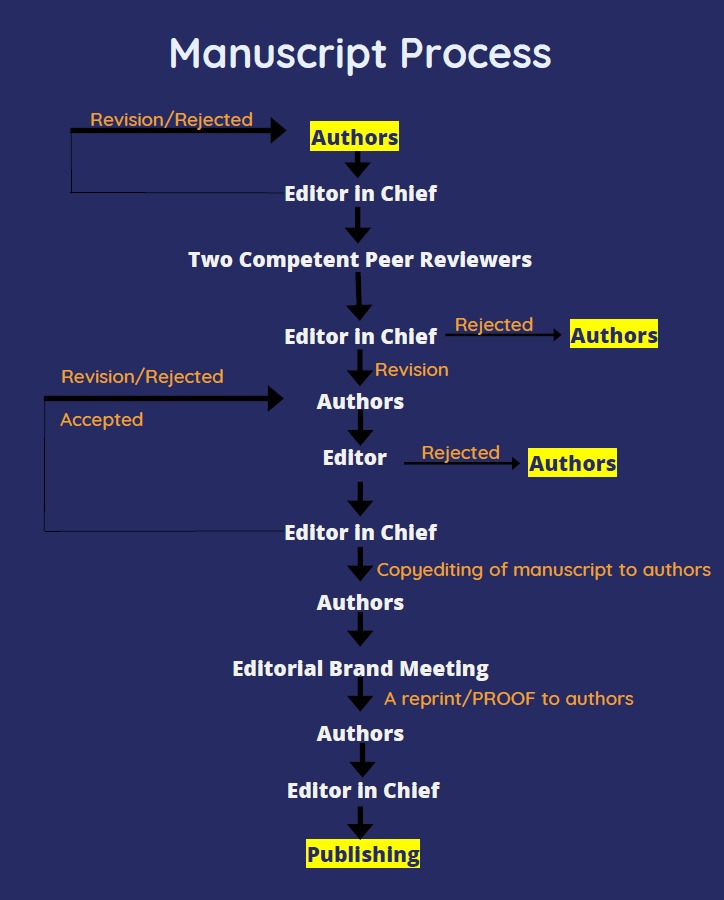
The Indonesian Journal of Dentistry (IJD) employs a rigorous peer-review process to ensure the scientific quality and integrity of published articles. The manuscript processing flow is outlined below:
1. Initial Screening (Pre-Review)
Upon submission, the Editor-in-Chief performs an initial check to ensure the manuscript adheres to the journal’s Focus and Scope and follows the Author Guidelines.
- Plagiarism Check: All manuscripts are screened for plagiarism using Turnitin. Manuscripts with high similarity indices will be rejected immediately.
- Decision: At this stage, the Editor-in-Chief may reject the manuscript (Desk Rejection) if it does not meet the standards or request immediate revisions before processing further.
2. Double-Blind Peer Review
Manuscripts passing the initial screening are assigned to two (2) or more competent peer reviewers. IJD adopts a Double-Blind Review policy, meaning the authors' identities are concealed from the reviewers, and vice versa. Reviewers evaluate the scientific merit, novelty, and methodology of the manuscript.
3. Editorial Decision and Revision
Based on the reviewers' comments, the Editor-in-Chief makes an interim decision:
- Accepted: The manuscript proceeds to the next stage.
- Revision Required: The manuscript is returned to the authors for modification. Authors must address all reviewers' comments.
- Rejected: The manuscript is declined due to lack of novelty, validity issues, or major flaws.
4. Post-Revision and Final Acceptance
Revised manuscripts are re-evaluated by the Assigned Editor. If the revision is satisfactory, the Editor-in-Chief issues a final acceptance. The accepted manuscript then undergoes a Copyediting process for linguistic and formatting corrections.
5. Production and Publication
- Editorial Board Meeting: Before publication, an Editorial Board Meeting is held to finalize the issue composition, considering the sequence of accepted dates, geographical distribution of authors, and thematic issues.
- Proofreading: A final reprint/galley proof is sent to the authors for confirmation.
- Publishing: The Editor-in-Chief approves the final version for online publication.
Open Access Policy
The Indonesian Journal of Dentistry (IJD) provides immediate open access to its content on the principle that making research freely available to the public supports a greater global exchange of knowledge. By adopting this model, IJD is committed to the dissemination of dental science and ensures that research findings are accessible to practitioners, researchers, and the general public without barriers.
Archiving
This journal utilizes the LOCKSS system to create a distributed archiving system among participating libraries and permits those libraries to create permanent archives of the journal for purposes of preservation and restoration. More...
Publication Ethics
Our Publication Ethics are based on COPE’s Best Practice Guidelines for Journal Editors.
Duties of Authors
Reporting Standards: Authors should present an accurate account of the original research performed as well as an objective discussion of its significance. Researchers should present their results honestly and without fabrication, falsification or inappropriate data manipulation. A manuscript should contain sufficient detail and references to permit others to replicate the work. Fraudulent or knowingly inaccurate statements constitute unethical behavior and are unacceptable. Manuscripts should follow the submission guidelines of the journal.
Originality and Plagiarism: Authors must ensure that they have written entirely original work. The manuscript should not be submitted concurrently to more than one publication unless the editors have agreed to co-publication. Relevant previous work and publications, both by other researchers and the authors’ own, should be properly acknowledged and referenced. The primary literature should be cited where possible. Original wording taken directly from publications by other researchers should appear in quotation marks with the appropriate citations.
Multiple, Redundant, or Concurrent Publications: Author should not in general submit the same manuscript to more than one journal concurrently. It is also expected that the author will not publish redundant manuscripts or manuscripts describing same research in more than one journal. Submitting the same manuscript to more than one journal concurrently constitutes unethical publishing behavior and is unacceptable. Multiple publications arising from a single research project should be clearly identified as such and the primary publication should be referenced
Acknowledgement of Sources: Authors should acknowledge all sources of data used in the research and cite publications that have been influential in determining the nature of the reported work. Proper acknowledgment of the work of others must always be given.
Authorship of the Paper: The authorship of research publications should accurately reflect individuals’ contributions to the work and its reporting. Authorship should be limited to those who have made a significant contribution to conception, design, execution or interpretation of the reported study. Others who have made significant contribution must be listed as co-authors. In cases where major contributors are listed as authors while those who made less substantial, or purely technical, contributions to the research or to the publication are listed in an acknowledgement section. Authors also ensure that all the authors have seen and agreed to the submitted version of the manuscript and their inclusion of names as co-authors.
Disclosure and Conflicts of Interest: All authors should clearly disclose in their manuscript any financial or other substantive conflict of interest that might be construed to influence the results or interpretation of their manuscript. All sources of financial support for the project should be disclosed.
Fundamental Errors in Published Works: If the author discovers a significant error or inaccuracy in the submitted manuscript, then the author should promptly notify the journal editor or publisher and cooperate with the editor to retract or correct the paper.
Hazards and Human or Animal Subjects: The author should clearly identify in the manuscript if the work involves chemicals, procedures or equipment that have any unusual hazards inherent in their use.
Duties of Editor
Publication Decisions: Based on the review report of the editorial board, the editor can accept, reject, or request modifications to the manuscript. The validation of the work in question and its importance to researchers and readers must always drive such decisions. The editors may be guided by the policies of the journal's editorial board and constrained by such legal requirements as shall then be in force regarding libel, copyright infringement and plagiarism. The editors may confer with other editors or reviewers in making this decision. Editors have to take responsibility for everything they publish and should have procedures and policies in place to ensure the quality of the material they publish and maintain the integrity of the published record.
Review of Manuscripts: Editor must ensure that each manuscript is initially evaluated by the editor for originality. The editor should organize and use peer review fairly and wisely. Editors should explain their peer review processes in the information for authors and also indicate which parts of the journal are peer reviewed. Editor should use appropriate peer reviewers for papers that are considered for publication by selecting people with sufficient expertise and avoiding those with conflicts of interest.
Fair Play: The editor must ensure that each manuscript received by the journal is reviewed for its intellectual content without regard to sex, gender, race, religion, citizenship, etc. of the authors. An important part of the responsibility to make fair and unbiased decisions is the upholding of the principle of editorial independence and integrity. Editors are in a powerful position by making decisions on publications, which makes it very important that this process is as fair and unbiased as possible.
Confidentiality: The editor must ensure that information regarding manuscripts submitted by the authors is kept confidential. Editors should critically assess any potential breaches of data protection and patient confidentiality. This includes requiring properly informed consent for the actual research presented, consent for publication where applicable.
Disclosure and Conflicts of Interest: The editor of the Journal will not use unpublished materials disclosed in a submitted manuscript for his own research without written consent of the author. Editors should not be involved in decisions about papers in which they have a conflict of interest
Duties of Reviewers
Confidentiality: Information regarding manuscripts submitted by authors should be kept confidential and be treated as privileged information. They must not be shown to or discussed with others except as authorized by the editor.
Acknowledgement of Sources: Reviewers must ensure that authors have acknowledged all sources of data used in the research. Reviewers should identify relevant published work that has not been cited by the authors. Any statement that an observation, derivation, or argument had been previously reported should be accompanied by the relevant citation. The reviewers should notify the journal immediately if they come across any irregularities, have concerns about ethical aspects of the work, are aware of substantial similarity between the manuscript and a concurrent submission to another journal or a published article, or suspect that misconduct may have occurred during either the research or the writing and submission of the manuscript; reviewers should, however, keep their concerns confidential and not personally investigate further unless the journal asks for further information or advice.
Standards of Objectivity: Review of submitted manuscripts must be done objectively and the reviewers should express their views clearly with supporting arguments. The reviewers should follow journals’ instructions on the specific feedback that is required of them and, unless there are good reasons not to. The reviewers should be constructive in their reviews and provide feedback that will help the authors to improve their manuscript. The reviewer should make clear which suggested additional investigations are essential to support claims made in the manuscript under consideration and which will just strengthen or extend the work
Disclosure and Conflict of Interest: Privileged information or ideas obtained through peer review must be kept confidential and not used for personal advantage. Reviewers should not consider manuscripts in which they have conflicts of interest resulting from competitive, collaborative, or other relationships or connections with any of the authors, companies, or institutions connected to the papers. In the case of double-blind review, if they suspect the identity of the author(s) notify the journal if this knowledge raises any potential conflict of interest.
Promptness: The reviewers should respond in a reasonable time-frame. The reviewers only agree to review a manuscript if they are fairly confident they can return a review within the proposed or mutually agreed time-frame, informing the journal promptly if they require an extension. In the event that a reviewer feels it is not possible for him/her to complete review of manuscript within stipulated time then this information must be communicated to the editor, so that the manuscript could be sent to another reviewer.
Abstracting & Indexing






.png)
_(1)1.png)
1.png)
Policy of Screening for Plagiarism
The Indonesian Journal of Dentistry (IJD) wants to ensure that all authors are careful and comply with international standards for academic integrity, particularly on the issue of plagiarism.
Generative AI Policy
This policy is based on and refers to the guidelines outlined in the Generative AI Policies for Journals, as provided by:
- STM: Recommendations for classifying AI use in academic manuscript preparation
- Elsevier: The application of generative AI and AI-assisted technologies within the review process.
- WAME: Chatbots, generative AI, and scholarly manuscripts
The Indonesian Journal of Dentistry (IJD) understands the importance of artificial intelligence (AI) and its potential to help authors with their research and writing processes. IJD is excited about the new possibilities that generative AI tools bring, especially for helping to come up with ideas, speed up research, analyze results, improve writing, organize submissions, assist authors who write in a second language, and speed up the research and sharing process. IJD is offering guidance to authors, editors, and reviewers on the use of such tools, which may evolve given the swift development of the AI field.
Generative Artificial Intelligence (AI) tools, including large language models (LLMs) and multimodal models, are continually developing and evolving, particularly in their applications for businesses and consumers. While generative AI possesses significant potential to enhance creativity for authors, it is important to acknowledge the associated risks that come with the current generation of these tools. Generative AI can produce a wide variety of content, encompassing text generation, image synthesis, audio, and synthetic data. Notable examples of such tools include ChatGPT, Copilot, Gemini, Claude, NovelAI, Jasper AI, DALL-E, Midjourney, and Runway.
Some of the risks associated with the operation of generative AI tools today are:
- Inaccuracy and bias: Generative AI tools are fundamentally statistical in nature rather than factual. Consequently, they can introduce inaccuracies, falsehoods (often referred to as hallucinations), or biases that may be difficult to detect, verify, and rectify.
- Lack of attribution: Generative AI frequently fails to adhere to the established practices within the global scholarly community regarding the correct and precise attribution of ideas, quotes, or citations.
- Confidentiality and intellectual property risks: Currently, generative AI tools are often employed on third-party platforms that may not provide adequate standards for confidentiality, data security, or copyright protection.
- Unintended uses: Providers of generative AI may repurpose input or output data generated from user interactions (for instance, for AI training). This practice has the potential to infringe upon the rights of authors and publishers, among others.
AUTHORS
Authors may use generative AI tools (e.g., ChatGPT, GPT models) for specific tasks, such as enhancing the grammar, language, and readability of their manuscripts. However, authors remain responsible for the originality, validity, and integrity of their submissions. When opting to use generative AI tools, it is essential that authors do so in a responsible manner and adhere to our journal's editorial policies concerning authorship and publication ethics. This responsibility encompasses reviewing the outputs produced by any AI tools and ensuring the accuracy of the content.
The Indonesian Journal of Dentistry (IJD) endorses the responsible use of generative AI tools, ensuring that high standards of data security, confidentiality, and copyright protection are maintained in instances such as the following:
- Idea generation and idea exploration
- Language improvement
- Interactive online search with LLM-enhanced search engines
- Literature classification
- Coding assistance
Authors are responsible for ensuring that the content of their submissions meets the required standards of rigorous scientific and scholarly assessment, research, and validation and is created by the author.
Generative AI tools should not be credited as authors, as they are unable to assume responsibility for the content submitted or to manage copyright and licensing agreements. Authorship necessitates accountability for the content, consent to publication through a publishing agreement, and the provision of contractual assurances regarding the integrity of the work, among other essential principles. These uniquely human responsibilities cannot be fulfilled by generative AI tools.
Authors must clearly acknowledge any use of generative AI tools in their articles by including a statement that specifies the full name of the tool (along with its version number), how it was used, and the reason behind it. For article submissions, this statement should be placed in either the Methods or Acknowledgements section. This transparency allows editors to assess the employment and responsible use of generative AI tools. The IJD will maintain discretion over the publication of the work to ensure that integrity and guidelines are upheld.
If an author intends to use an AI tool, they must ensure that it is suitable and robust for their intended purpose. Additionally, they should verify that the terms associated with such a tool offer adequate safeguards and protections, particularly concerning intellectual property rights, confidentiality, and security.
Authors should avoid submitting manuscripts that use generative AI tools in ways that compromise fundamental researcher and author responsibilities, for example:
- Text or code generation without rigorous revision
- Synthetic data generation to substitute missing data without robust methodology
- Generation of any types of content that are inaccurate, including abstracts or supplemental materials
These types of cases may be subject to editorial investigation.
IJD currently prohibits the use of generative AI in the creation and manipulation of images and figures, as well as original research data, for inclusion in our publications. The term “images and figures” encompasses pictures, charts, data tables, medical imagery (e.g., radiographs, histological slides, intraoral photos), snippets of images, computer code, and formulas. “Manipulation” refers to augmenting, concealing, moving, removing, or introducing specific features within an image or figure.
Human oversight and transparency must consistently inform the use of generative AI and AI-assisted technologies throughout every stage of the research process. Research ethics guidelines are continuously being revised to reflect advancements in generative AI technologies. The IJD will continue to update our editorial guidelines as both the technology and ethical standards in research develop.
EDITORS AND PEER REVIEWERS
Indonesian Journal of Dentistry (IJD) is committed to maintaining the highest standards of editorial integrity and transparency. Editors and peer reviewers using manuscripts in generative AI systems could risk breaking confidentiality, ownership rights, and privacy, including personal information. Consequently, editors and peer reviewers are prohibited from uploading files, images, or information from unpublished manuscripts into generative AI tools. Non-compliance with this policy may violate the intellectual property rights of the rightsholder.
Editors: Editors play a crucial role in maintaining the quality and integrity of research content. Consequently, it is imperative that editors maintain confidentiality regarding submission and peer review details. The use of manuscripts within generative AI systems could pose significant risks related to confidentiality, as well as potential infringements on proprietary rights, data security, and other concerns. Therefore, editors are prohibited from uploading unpublished manuscripts, along with any associated files, images, or information, into generative AI tools.
Peer Reviewers: Peer reviewers, who are selected as subject-matter experts, should refrain from utilizing generative AI to evaluate or condense submitted articles, or any portion of them, when writing their reviews. Consequently, peer reviewers must not upload unpublished manuscripts or project proposals, nor any associated files, images, or information, into generative AI tools. Generative AI may only be employed to assist in enhancing the language of the review; however, peer reviewers will always be accountable for ensuring the accuracy and integrity of their assessments.
Repository Policy
Indonesian Journal of Dentistry (IJD) has the following repository policy:
1. Submitted Version
Submitted Version IJD allows authors to store their submitted manuscript in their personal repositories or other repositories which cannot be accessed by public. These repositories include but not limited to Google Drive, Dropbox, One Drive, and Apple iCloud.
2. Accepted Version
Accepted Version IJD allows authors to store their submitted manuscript in their personal repositories or other repositories which cannot be accessed by public. These repositories include but not limited to Google Drive, Dropbox, One Drive, and Apple iCloud.
3. Published Version
Published Version IJD allows and encourages authors to store their published version (pdf version) in their institutional repositories, personal repositories, and other repositories, and make it accessible for any use, even commercially, with proper retribution. All of published articles in Indonesian Journal of Dentistry are deposited in Portal Garuda repository and Sinta.
Retraction Policy
Article Retraction
At Indonesian Journal of Dentistry (IJD), we have a commitment to maintaining the integrity of the academic record, so there are times when there is a need to retract articles. An article would be retracted for the following reasons:
If there are major scientific errors that will invalidate the article's conclusion. An example is when there is evidence that the findings in the article are unreliable either due to an honest error (a miscalculation or experimental error) or as a result of misconduct (data fabrication).
If the research and resulting findings have already been posted elsewhere without appropriate cross-referencing, justification, or permission (redundant publication).
If there are plagiarism issues—the use of words or ideas from another publication without giving credit—or inappropriate authorship.
To make sure that retractions are handled according to the best practices of publication, and in accordance with COPE Retraction Guidelines, IJD follows the retraction process below:
Any article that requires potential retraction should be brought to the notice of the journal editor.
Once this is done, the journal editor follows the guidelines according to the COPE flowcharts, including the evaluation of responses provided by the authors regarding the concerns raised.
The editor's findings are then consulted with the Editorial Board / Ethics Advisory Board before any formal action is taken. This step ensures a consistent approach in accordance with industry best practices.
The decision on whether or not the publication will be retracted is communicated to the authors and other relevant bodies, such as the author's affiliated institution, if deemed necessary.
When the process is concluded, a retraction statement is posted online and published in the next available issue of the journal.
Note: Even if the author retains copyright for an article, this does not grant the right to unilaterally retract it after publication. The integrity of the public scientific record is paramount, and COPE's Retraction Guidelines strictly apply in such cases.
Article Withdrawal
It is not within the jurisdiction of an author to freely withdraw a submitted manuscript once processing has begun. Referees, editors, and editorial staff dedicate substantial time and effort to evaluating and editing submitted manuscripts, making unjustified sudden withdrawals an unnecessary waste of resources. Before an author submits a manuscript through our OJS, the author must acknowledge the following provisions:
If the author requests the removal or withdrawal of their manuscript while it is still in the peer-review process, the authors will be barred from submitting manuscripts to IJD for one (1) year following the withdrawal date.
If the author requests to withdraw the article after it has been accepted for publication, the authors will be barred from submitting manuscripts to IJD for two (2) years following the withdrawal date.
If an article published as an “Article in Press” (accepted and posted prior to final formal volume/issue assignment) contains severe errors, violates the Journal Publishing Ethics Guidelines as determined by editors, is found to duplicate another published work, or is withdrawn from the IJD website, the authors will be barred from submitting manuscripts to IJD for three (3) years following the withdrawal date. The term "Withdrawn" means that the article's content is replaced with a PDF/HTML notice stating that the article has been withdrawn.
If an author refuses to resolve applicable withdrawal penalties or procedural obligations, the author, alongside associated affiliations/co-authors, may be blacklisted from publication in IJD for up to three (3) years.
Any official request to withdraw a manuscript must be submitted via a formal letter signed by the author and the head/dean/director of the corresponding institution/agency, addressed directly to the Editor-in-Chief / Principal Editor.
Article Correction
Issuing a formal correction is considered by IJD under the following circumstances:
A small portion of an otherwise reliable publication reports flawed data or misleading details arising from an honest error.
The author/contributor list contains errors (e.g., a qualifying author was inadvertently omitted, or an individual who does not meet authorship criteria was improperly included).
Corrections to peer-reviewed content fall into one of three categories:
Publisher correction (erratum): Notifies readers of a significant error introduced by journal production/publishing staff that impacts the scientific clarity, publication record, or reputation of the journal or authors.
Author correction (corrigendum): Notifies readers of an error made directly by the authors that impacts the scientific integrity of the work or the academic record.
Addendum: An addition submitted by the authors to clarify ambiguities, address inconsistencies, or provide necessary updates/expansion to the original article.
Decisions regarding whether a correction is warranted rest with the journal editors, often in consultation with reviewers or editorial board members. Handling editors will contact the corresponding author for clarification, but the final determination of the correction type and publication rests solely with the editorial team.
Article Removal
In rare and extraordinary circumstances, it may be necessary to remove a published article from the online platform. This occurs only if the article is found to be defamatory, infringes upon legal rights or patents, or if compliance with a formal court order is mandated. In such cases, the bibliographic metadata (title, authors, abstract, DOI) will remain accessible, while the full text is replaced with a notification stating that the article has been removed for legal or compliance reasons.
Article Replacement
In rare cases where an article contains severe flaws that cannot be rectified by a simple correction, the author and editors may agree to retract the flawed original and replace it with a corrected version. Under these circumstances, formal retraction procedures are followed; the retraction notice will clearly state the rationale and include a direct link to the newly published, corrected version, complete with a full document version history.
 |  | Indonesian Journal of Dentistry (IJD)
OFFICE: |
